
3 September 2026 · Marine Boys
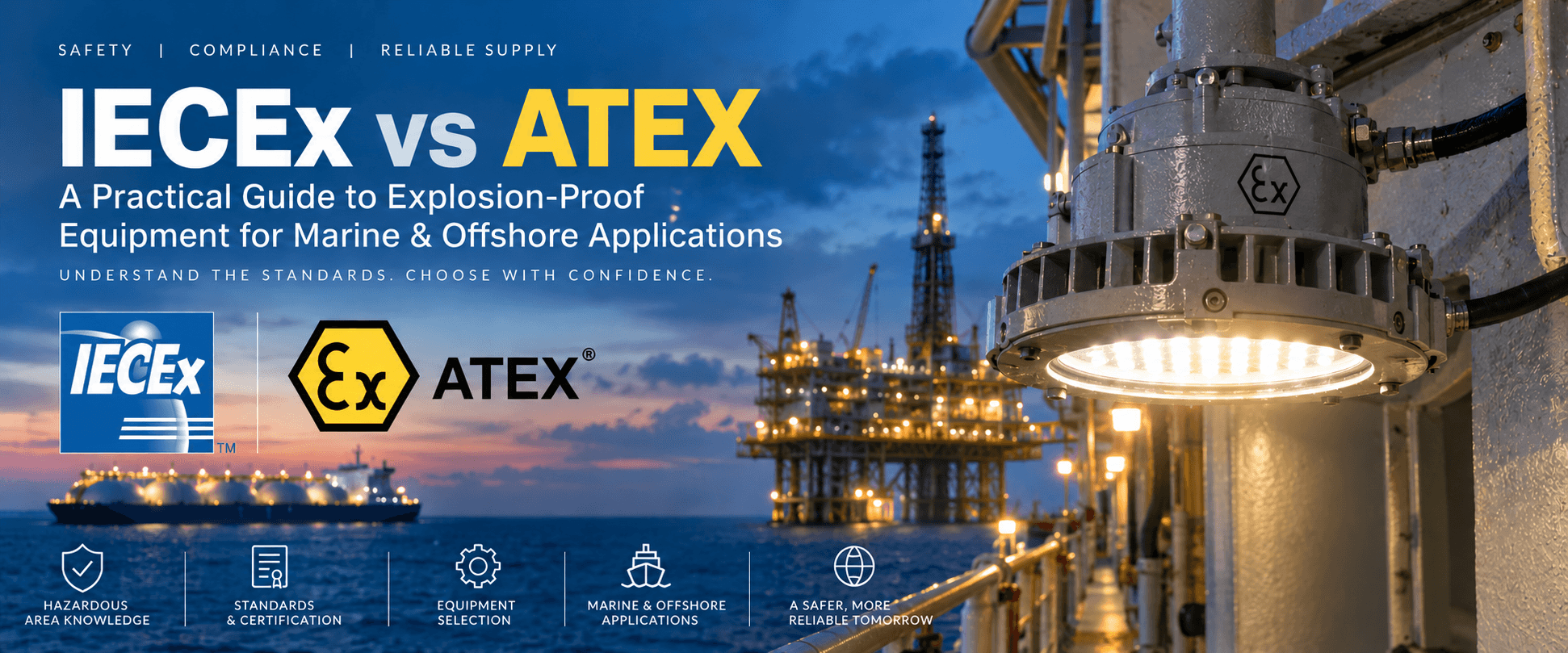
IECEx vs ATEX: A Practical Guide to Explosion-Proof Equipment for Marine & Offshore Applications
Understand the difference between IECEx and ATEX certification, hazardous area Zones, Ex markings, gas groups and temperature classes for marine and offshore equipment.
What Are IECEx and ATEX?
Electrical equipment installed in hazardous areas must be designed so that it does not become an ignition source for flammable gases, vapours or combustible dust.
This is particularly important in marine and offshore environments such as oil and gas platforms, FPSOs, tankers, LNG/LPG vessels, chemical carriers and other locations where potentially explosive atmospheres may occur.
Two terms frequently encountered when specifying explosion-protected equipment are IECEx and ATEX.
Although they are closely related and often use similar technical standards, IECEx and ATEX are not the same certification system.
In simple terms:
IECEx is an international conformity-assessment system for equipment and services associated with explosive atmospheres.
ATEX refers to European Union legislation governing equipment and workplaces involving potentially explosive atmospheres.
The IECEx system is based on international IEC and ISO standards, particularly the IEC 60079 series for explosive atmospheres.
Understanding the difference is important when selecting lighting, junction boxes, control equipment, cable glands, motors, sensors and other electrical equipment for marine and offshore installations.
IECEx vs ATEX – What's the Difference?
Both systems aim to reduce the risk of ignition in hazardous environments, but their regulatory structures are different.
IECExATEXScopeInternationalEuropean UnionTypeInternational certification systemEU regulatory frameworkMain technical basisIEC/ISO standardsHarmonised European standards, often aligned with IEC standardsEquipment certificationIECEx Certificate of ConformityATEX conformity assessmentMain marketGlobal / participating marketsEU / EEAManufacturer quality assessmentPart of IECEx equipment certification systemRequired according to applicable ATEX conformity procedureMarkingIECEx / Ex markingCE + Ex-related ATEX marking
The IECEx organisation itself publishes a dedicated guide comparing IECEx and ATEX, reflecting that the two systems have many technical similarities but important differences in conformity assessment and legal status.
For international marine and offshore projects, it is therefore important not to assume that an ATEX certificate automatically satisfies every IECEx or local regulatory requirement, or vice versa.
The project specification, flag/class requirements, installation location and applicable national regulations should always be checked.
What Is a Hazardous Area?
A hazardous area is a location where a potentially explosive atmosphere may be present in sufficient quantity that special precautions are required when selecting and installing electrical or mechanical equipment.
In marine and offshore applications, potentially hazardous locations can include:
tanker cargo areas
LNG and LPG handling areas
FPSO process areas
offshore drilling platforms
fuel transfer and bunker stations
chemical handling areas
paint and solvent storage areas
battery or gas-handling spaces
hydrocarbon processing equipment
The presence of flammable gas does not mean every location receives the same equipment requirement.
The area must first be classified according to the probability and duration of an explosive atmosphere being present.
IEC 60079-10-1 addresses area classification for explosive gas atmospheres, while IEC 60079-10-2 covers explosive dust atmospheres.
Understanding Zone 0, Zone 1 and Zone 2
For explosive gas atmospheres, hazardous areas are commonly classified as Zone 0, Zone 1 or Zone 2.
Zone 0
An explosive gas atmosphere is present continuously, for long periods or frequently.
This represents the highest level of hazardous-area exposure.
Typical applications may include the interior of certain process vessels or tanks where flammable vapours are continuously present.
Zone 1
An explosive gas atmosphere is likely to occur occasionally during normal operation.
Zone 1 is common in oil, gas, petrochemical and offshore facilities.
Many explosion-protected marine lights, junction boxes, control stations and other Ex products are therefore designed for Zone 1 applications.
Zone 2
An explosive gas atmosphere is not likely to occur during normal operation, and if it does occur, it normally exists only for a short period.
Zone 2 generally presents a lower probability of an explosive atmosphere than Zone 1, but equipment selection and installation still require appropriate hazardous-area consideration.
What Do Ex d, Ex e and Ex i Mean?
You may see equipment marked with designations such as:
Ex db
Ex eb
Ex ia
These identify different types of explosion protection.
Ex d – Flameproof Enclosure
With flameproof protection, electrical components capable of causing ignition are enclosed within a specially designed enclosure.
If an explosion occurs inside the enclosure, the enclosure is designed to withstand the pressure and prevent the internal explosion from igniting the surrounding explosive atmosphere.
IEC 60079-1 covers equipment protection using flameproof enclosures "d".
Typical applications include:
explosion-proof lighting
motors
switches
control equipment
electrical enclosures
Ex e – Increased Safety
Increased-safety equipment is designed with additional measures to prevent excessive temperatures, electrical arcs and sparks during normal operation.
IEC 60079-7 covers equipment protection by increased safety "e".
Common applications include:
terminal boxes
junction boxes
luminaires
connection equipment
certain motors
Ex i – Intrinsic Safety
Intrinsic safety limits electrical and thermal energy so that the circuit cannot normally produce enough energy to ignite the specified explosive atmosphere.
IEC 60079-11 covers protection by intrinsic safety "i".
It is commonly associated with:
sensors
instrumentation
transmitters
measurement equipment
communication circuits
Other protection concepts also exist, including pressurisation "p", oil/liquid immersion "o", powder filling "q", and dust protection by enclosure "t".
How to Read an Explosion-Proof Equipment Marking
A typical Ex product may carry a marking similar to:
Ex db IIC T6 Gb
At first glance this can appear complicated, but each part provides important information about where the equipment may be used.
Let's break it down.
Ex
Indicates equipment designed for use in an explosive atmosphere according to the relevant Ex protection system.
db
Indicates the protection technique and protection level.
In this example, "d" represents flameproof enclosure protection.
IIC
Indicates the gas group for which the equipment has been assessed.
T6
Indicates the equipment's temperature class.
Gb
Indicates the Equipment Protection Level (EPL).
These markings should be considered together. Selecting an Ex product simply because it says "explosion proof" is not sufficient.
Understanding Gas Groups – IIA, IIB and IIC
Explosive gases are grouped according to their ignition characteristics.
For Group II equipment used in gas atmospheres outside mining applications, you will commonly encounter:
Gas GroupRepresentative gas often associated with the groupIIAPropaneIIBEthyleneIICHydrogen / acetylene
IIC represents the more demanding gas-group classification.
Equipment certified for IIC applications can therefore offer broader gas-group coverage, subject to the complete certification, temperature class, EPL and installation requirements.
However, gas group is only one part of equipment selection.
Temperature Classes – T1 to T6
A flammable gas can potentially ignite if it contacts a sufficiently hot surface.
Explosion-protected equipment is therefore assigned a temperature class according to its maximum permitted surface temperature under specified conditions.
Temperature ClassMaximum Surface Temperature
T1 450°C T2 300°C T3 200°C T4 135°C T5 100°C T6 85°C
A T6-rated product has a lower permitted maximum surface temperature than a T4-rated product.
This does not simply mean "T6 is always better." The equipment must be selected to suit the ignition temperature of the gas or vapour and the requirements of the installation.
Equipment Protection Levels – Ga, Gb and Gc
IEC hazardous-area equipment also uses Equipment Protection Levels (EPLs).
For gas atmospheres:
EPL Protection Level Typical Zone Association
Ga Very high Zone 0
Gb High Zone 1
Gc Enhanced Zone 2
The actual equipment selection must still consider the complete hazardous-area classification and installation requirements rather than relying on the zone alone.
What Does ATEX Marking Look Like?
ATEX equipment may include markings such as:
II 2G Ex db IIC T6 Gb
ATEX introduces additional information such as equipment group and category.
For example:
II – equipment for industries other than underground mining
2 – equipment category
G – explosive atmosphere caused by gas, vapour or mist
This is one reason IECEx and ATEX labels can look similar while not being identical.
The underlying explosion-protection concepts may be based on closely aligned technical standards, but the certification and regulatory frameworks remain different.
IECEx and ATEX in Australia
For Australian installations, the AS/NZS 60079 series is particularly important.
Western Australian WorkSafe guidance, for example, identifies the AS/NZS 60079 series for hazardous areas and specifically references:
AS/NZS 60079.10.1 for explosive gas atmosphere area classification
AS/NZS 60079.10.2 for combustible dust atmosphere classification.
Australian requirements therefore should not be approached simply by asking:
"Does this product have ATEX?"
Instead, purchasers and engineers should establish the actual hazardous-area classification and applicable Australian/project requirements before selecting equipment.
Depending on the installation, certification documentation and compliance with relevant AS/NZS 60079 requirements may need to be verified by the responsible engineer or hazardous-area competent person.
IECEx Certification Is More Than an "Ex" Label
A product displaying an Ex-style marking should not automatically be assumed to have valid IECEx certification.
Under the IECEx Certified Equipment Scheme, certification involves independent third-party testing and assessment against relevant international standards. The manufacturer's quality system is also subject to assessment to provide confidence that production equipment continues to conform to the certified design.
IECEx certificates are maintained through the IECEx online certification system.
For critical marine and offshore equipment, purchasers should therefore consider checking:
Manufacturer → Model → IECEx Certificate Number → Certificate Status → Applicable Standards → Schedule/Conditions of Certification
rather than relying solely on a supplier's catalogue description.
IECEx Online Certificate System and official IECEx resources
Selecting Ex Equipment for Marine & Offshore Applications
When specifying explosion-protected equipment, consider more than simply IECEx or ATEX certification.
Important information may include:
1. Hazardous area classification
Is the installation Zone 0, Zone 1 or Zone 2?
2. Gas or dust atmosphere
What flammable substance can be present?
3. Gas group
Is IIA, IIB or IIC required?
4. Temperature class
What maximum surface temperature is permitted?
5. Equipment Protection Level
Is Ga, Gb or Gc required?
6. Protection method
Is the equipment Ex d, Ex e, Ex i or another protection concept?
7. Ambient temperature
Does the certificate cover the actual environmental temperature range?
8. IP protection
Marine installations may require a high level of protection against water, salt spray and dust.
9. Materials and corrosion resistance
Stainless steel, marine-grade aluminium and appropriate coatings may be important for offshore environments.
10. Certification documentation
Always verify that the exact model and configuration being supplied are covered by the relevant certificate.
Common Ex Equipment Used Offshore
Hazardous-area electrical systems may include:
Explosion-Proof Lighting
LED floodlights
fluorescent/LED luminaires
emergency lights
portable lights
Electrical Equipment
junction boxes
control stations
switches
plugs and sockets
distribution boxes
Cable Accessories
Ex cable glands
stopping plugs
reducers and adaptors
junction accessories
Instrumentation
sensors
transmitters
gas detectors
monitoring equipment
For marine and offshore projects, certification should always be checked against the specific equipment model and intended installation, rather than assuming that every product from a particular manufacturer has the same Ex approval.
IECEx or ATEX – Which Should You Specify?
There isn't one universal answer.
For equipment intended for the European market, ATEX requirements are particularly important because ATEX forms part of the EU regulatory framework.
For international marine, offshore, oil & gas and industrial projects, IECEx is widely used as an international certification framework.
Some manufacturers therefore supply equipment carrying both IECEx and ATEX certification, allowing the same product platform to serve multiple markets.
The key point is:
Certification must match the project's applicable standards, hazardous-area classification and regulatory requirements.
IECEx itself describes its objective as facilitating international trade in Ex equipment through internationally recognised certification and a common approach to assessment.
Marine & Offshore Explosion-Proof Equipment Supply
Marine Boys supplies marine and offshore electrical equipment for shipbuilding, vessel maintenance, offshore projects and industrial applications in Australia.
Our product range includes marine lighting, explosion-protected lighting, electrical components, marine and offshore cables and related equipment from established Korean and international manufacturers.
When sourcing hazardous-area equipment, providing the following information with your enquiry can help identify the correct product:
Manufacturer / Model
Required Zone
IECEx or ATEX requirement
Ex classification / marking
Gas group
Temperature class
Voltage / Frequency
IP rating
Required certificate or class approval
Quantity
For replacement equipment, a photo of the existing nameplate is particularly useful.
IECEx vs ATEX: A Practical Guide to Explosion-Proof Equipment for Marine & Offshore Applications

Understand the difference between IECEx and ATEX certification, hazardous area Zones, Ex markings, gas groups and temperature classes for marine and offshore equipment.

Read more → https://www.marineboys.com.au/blog/iecex-vs-atex-explosion-proof-marine-offshore-guide

#IECEx #ATEX #ExplosionProof #HazardousAreas #MarineEngineering #OffshoreEngineering #MarineElectrical #OffshoreIndustry #MarineLighting #OilAndGas #MaritimeIndustry #MarineBoys
Copy the caption, click Open LinkedIn, paste, and attach the cover image.