
8 October 2026 · Marine Boys
RFOU vs BFOU Offshore Cables | NEK 606 Selection Guide
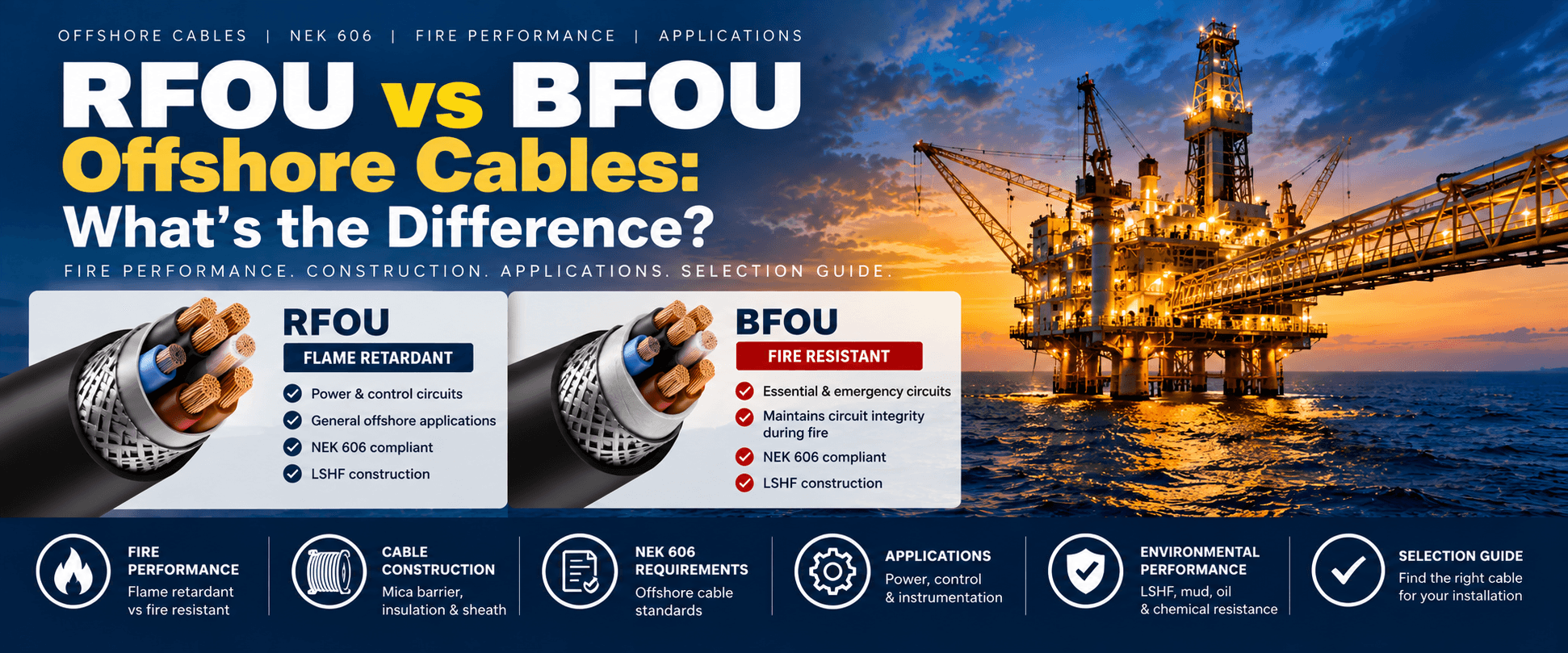
Understand the differences between RFOU and BFOU offshore cables, including fire performance, construction, NEK 606 requirements, applications and cable selection.
1. Introduction
Offshore oil and gas installations, FPSOs, drilling platforms and marine vessels require electrical cables designed to withstand demanding environmental and operating conditions.
Two commonly specified offshore cable types are RFOU and BFOU.
Both are associated with offshore cable specifications such as NEK TS 606, but they have different fire-performance characteristics.
The main distinction is:
RFOU: Flame-retardant offshore cable, typically used for general power and control applications.
BFOU: Fire-resistant offshore cable, designed to maintain electrical circuit integrity during specified fire conditions.
Understanding these differences is essential when selecting cables for offshore installations, particularly where fire safety and emergency system reliability are critical.
2. RFOU vs BFOU – Quick Comparison
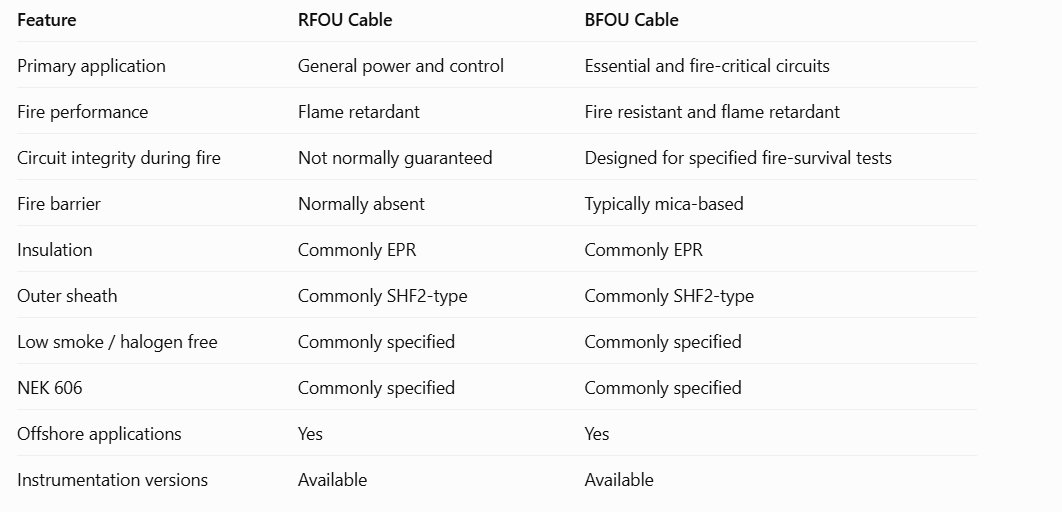
Important: Actual construction, voltage rating, fire performance and certification vary by manufacturer and cable designation. Always confirm the product datasheet.
3. What Is RFOU Offshore Cable?
RFOU is a commonly used designation for flame-retardant offshore power and control cables.
These cables are designed for demanding offshore environments where electrical reliability, mechanical durability and appropriate fire performance are required.
Typical RFOU applications
RFOU cables may be used for:
General offshore power distribution
Motors and pumps
Machinery control systems
Switchboards and electrical panels
Ventilation equipment
Offshore processing machinery
Non-fire-critical electrical circuits
RFOU cables are available in various conductor sizes, core configurations and voltage ratings.
For example:
RFOU 0.6/1 kV – 3 × 2.5 mm²
This describes a three-core cable with 2.5 mm² nominal conductor cross-sectional area per core and a 0.6/1 kV voltage designation.
However, the full specification should also confirm the cable construction, applicable standards and required approvals.
Is RFOU fire resistant?
Not necessarily.
RFOU cables are generally flame retardant, meaning they are designed to limit flame propagation under specified test conditions.
This does not automatically mean they can maintain electrical circuit integrity during a fire.
For circuits that must remain operational during fire exposure, a suitable fire-resistant cable such as BFOU may be required.
4. What Is BFOU Offshore Cable?
BFOU is a commonly used designation for fire-resistant offshore power and control cables.
These cables are designed to maintain electrical circuit integrity during specified fire-resistance tests.
This additional capability is particularly important for essential safety systems.
Typical BFOU applications
Depending on the approved installation design, BFOU cables may be specified for:
Emergency power circuits
Fire detection and alarm systems
Emergency shutdown systems
Emergency lighting
Essential control circuits
Critical communication systems
Fire pumps and associated safety equipment
Not every circuit in these systems automatically requires BFOU. The cable selection must follow the approved cable schedule and relevant fire-safety requirements.
Why is BFOU fire resistant?
BFOU cables typically incorporate an additional mica-based fire barrier around the conductors.
This helps maintain insulation and conductor separation during specified fire exposure.
The exact construction and tested fire-survival performance depend on the manufacturer and applicable standard.
5. Flame Retardant vs Fire Resistant
This is the most important difference between RFOU and BFOU.
Flame-retardant cable
A flame-retardant cable is designed to limit the spread of flame under specified testing conditions.
However, the cable may lose electrical functionality during a fire.
Fire-resistant cable
A fire-resistant cable is designed to maintain electrical circuit integrity during a defined fire test.
This is important for systems that must continue operating during an emergency.
Flame retardant does not mean fire resistant.
Likewise, fire resistance does not mean a cable can operate indefinitely in any fire.
Actual performance depends on the relevant test standard, temperature, duration and installation conditions.
Related article:
Fire Resistant vs Flame Retardant Marine Cables
6. RFOU vs BFOU Cable Construction
RFOU and BFOU cables share many construction features.
Typical offshore cable construction may include:
Stranded copper conductors, often tinned for corrosion resistance
EPR insulation
Halogen-free bedding or inner covering
Tinned copper wire braid
Protective outer sheath, commonly an SHF2-type compound
The main construction difference is that BFOU typically incorporates an additional fire-resistant barrier, often mica-based.
Typical construction comparison
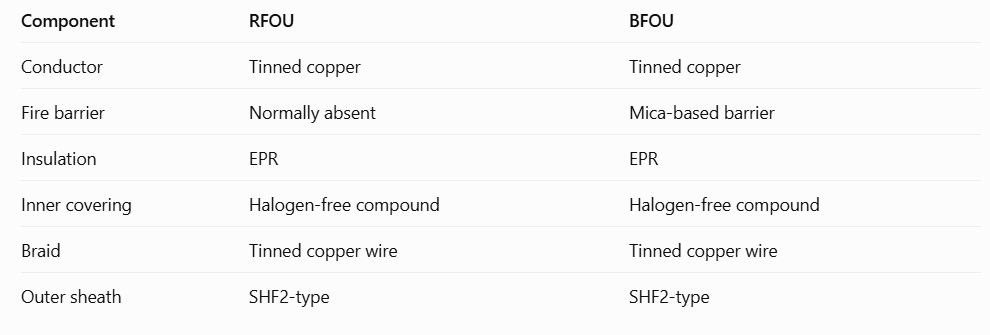
These are representative constructions. The actual manufacturer's datasheet must be checked before ordering.
7. What Is NEK 606?
NEK TS 606 is a Norwegian technical specification widely used for offshore electrical cables.
It addresses cable requirements for demanding offshore environments, including offshore oil and gas installations.
Typical applications include:
Offshore production platforms
FPSOs and FSOs
Drilling installations
Offshore processing modules
Fixed and mobile offshore facilities
NEK 606 is used alongside relevant IEC cable standards.
Important cable standards
Standard
Main purpose
NEK TS 606
Offshore cable specifications
IEC 60092-350
General construction and testing requirements
IEC 60092-353
Certain low-voltage power cables
IEC 60092-376
Control and instrumentation cables
IEC 60332
Flame propagation testing
IEC 60331
Circuit integrity under fire conditions
IEC 61034
Smoke density testing
IEC 60754
Halogen gas and acidity testing
The applicable standards and editions depend on the cable type and project specification.
Related article:
O-Route NEK-606 Offshore Cable Guide
8. Are RFOU and BFOU Low Smoke Halogen Free?
RFOU and BFOU cables manufactured to common NEK 606 constructions generally incorporate low-smoke, halogen-free materials.
These materials are particularly important in offshore installations, where smoke and corrosive combustion gases can threaten personnel and damage equipment.
However, three different performance characteristics should be distinguished:
Flame retardancy: Limits flame propagation.
Low smoke / halogen free: Addresses smoke emissions and halogen-related combustion products.
Fire resistance: Addresses continued electrical circuit operation during specified fire exposure.
A cable may meet low-smoke and halogen-free requirements without being fire resistant.
Related article:
Marine Shipboard Cables – Low Smoke Halogen Free
9. What Do RFOU(i), RFOU(c), BFOU(i) and BFOU(c) Mean?
RFOU and BFOU designations are also used for offshore instrumentation cables.
Instrumentation cables transmit measurement and control signals from equipment such as:
Pressure transmitters
Temperature sensors
Level transmitters
Flow instruments
Monitoring systems
Process automation equipment
These signals can be sensitive to electromagnetic interference.
Individually screened – (i)
An (i) designation is commonly used for individual screening of instrumentation pairs or triples.
This helps reduce interference between signal circuits.
Example:
RFOU(i) – 12 pairs × 1.5 mm²
Collectively screened – (c)
A (c) designation is commonly used for a shared screen around grouped instrumentation elements.
Example:
BFOU(c) – 6 pairs × 1.5 mm²
Screening arrangements and suffix conventions should always be verified against the manufacturer's designation system.
10. Can RFOU Be Replaced with BFOU?
This is a common purchasing question.
Replacing BFOU with RFOU
Generally, no—not without formal engineering assessment and approval.
If BFOU was specified because a circuit must remain operational during fire exposure, substituting RFOU could remove the required fire-survival capability.
Replacing RFOU with BFOU
BFOU may provide additional fire-resistant performance, but it is not automatically a direct replacement.
Before substitution, confirm:
Voltage rating
Conductor size and number of cores
Current-carrying capacity
Cable outside diameter
Minimum bending radius
Screening and braid construction
Cable gland and termination compatibility
Environmental resistance
Required certification
A higher fire-performance classification does not automatically establish electrical and mechanical compatibility.
11. Mud Resistance and Offshore Environmental Conditions
Offshore cables may be exposed to:
Drilling fluids
Hydrocarbon-based oils
Cleaning chemicals
Saltwater
UV radiation
Temperature variations
Vibration and mechanical stress
Certain NEK 606 cable constructions use specialised sheath materials to resist these conditions.
However, not every RFOU or BFOU cable has identical chemical-resistance performance.
For applications involving drilling mud or aggressive fluids, confirm the exact sheath designation and manufacturer's test documentation.
Ordinary BFOU fire resistance should also not be confused with specialised hydrocarbon-fire or jet-fire resistance, which may require separately tested cable constructions.
12. How to Read an RFOU or BFOU Cable Specification
Consider the following example:
BFOU – 0.6/1 kV – 3C × 6 mm² – NEK 606
Specification
Meaning
BFOU
Fire-resistant offshore cable family
0.6/1 kV
Rated voltage designation
3C
Three conductors
6 mm²
Nominal cross-sectional area of each conductor
NEK 606
Requested offshore cable specification
Before ordering, confirm the required standard edition, construction, sheath performance and certification.
For instrumentation cable, an enquiry might read:
RFOU(i) – 12P × 1.5 mm² – 150/250 V
Here, 12P indicates twelve pairs, while (i) commonly indicates individually screened instrumentation elements.
13. Which Cable Should You Choose?
Choose RFOU when:
The approved cable schedule specifies a flame-retardant offshore cable for general power or control applications without a fire-survival requirement.
Choose BFOU when:
The approved cable schedule requires fire-resistant performance to maintain circuit integrity during specified fire exposure.
Choose an appropriate instrumentation variant when:
The circuit carries measurement or control signals and requires specific screening arrangements to manage electromagnetic interference.
The final selection must follow the project's engineering specification, approved cable schedule and applicable installation requirements.
14. Offshore Cable Purchasing Checklist
Before requesting a quotation for RFOU or BFOU cables, confirm:
RFOU or BFOU designation
Power, control or instrumentation application
Rated voltage
Number of cores, pairs or triples
Conductor cross-sectional area
Individual or collective screening
Fire-resistance requirements
NEK 606 edition and applicable IEC standards
Mud, oil and chemical resistance
Sheath type and colour
Required class or third-party approvals
Cable length and delivery location
Providing a complete specification helps avoid unsuitable substitutions, quotation delays and incorrect deliveries.
15. RFOU and BFOU Offshore Cable Supply in Australia
Marine Boys supports marine and offshore customers with sourcing electrical cables for ship maintenance, offshore installations and project requirements.
Our cable sourcing activities include enquiries for:
RFOU offshore cables
BFOU fire-resistant cables
NEK 606 cable types
Offshore power and control cables
Screened instrumentation cables
Low-smoke, halogen-free marine cables
Specialised Korean marine and offshore cable products
Cable availability, manufacturer options and certification requirements should be confirmed for each enquiry.
Need a Quotation for RFOU or BFOU Cable?
Send Marine Boys your cable specification, existing sheath marking or datasheet, together with the required length and delivery location.
We can assist with identifying suitable sourcing options and reviewing available product documentation against your requested specification.
Contact Marine Boys:
Frequently Asked Questions
Is BFOU better than RFOU?
BFOU provides additional fire-resistant performance, but it is not necessarily the better choice for every circuit. The appropriate cable depends on the required fire classification and installation design.
Is RFOU cable fire resistant?
Standard RFOU is generally flame retardant rather than fire resistant. Check the manufacturer's exact test certification.
What is the main difference between RFOU and BFOU?
BFOU typically includes a mica-based fire barrier to maintain circuit integrity during specified fire tests, whereas standard RFOU does not.
Are RFOU and BFOU cables suitable for offshore oil and gas applications?
Yes. Appropriately specified RFOU and BFOU cable constructions are widely used in offshore oil and gas installations. Environmental, fire and electrical characteristics must be verified.
Does NEK 606 compliance mean every cable is mud resistant?
No. Confirm the specific cable designation, sheath construction and documented resistance to the fluids involved.
Can BFOU be used for instrumentation?
Yes. BFOU instrumentation variants are available, including individually and collectively screened constructions.
RFOU vs BFOU Offshore Cables | NEK 606 Selection Guide

Understand the differences between RFOU and BFOU offshore cables, including fire performance, construction, NEK 606 requirements, applications and cable selection.

Read more → https://www.marineboys.com.au/blog/rfou-vs-bfou-offshore-cable-guide

#RFOU #BFOU #NEK606 #OffshoreCable #MarineCable #MarineEngineering #OffshoreEngineering #MarineBoys
Copy the caption, click Open LinkedIn, paste, and attach the cover image.