7 October 2026 · Marine Boys
Marine Searchlights vs Floodlights vs Spreader Lights | Selection Guide
Understand the difference between marine searchlights, floodlights and spreader lights. Compare beam patterns, applications, mounting positions and LED selection for ships and offshore vessels.
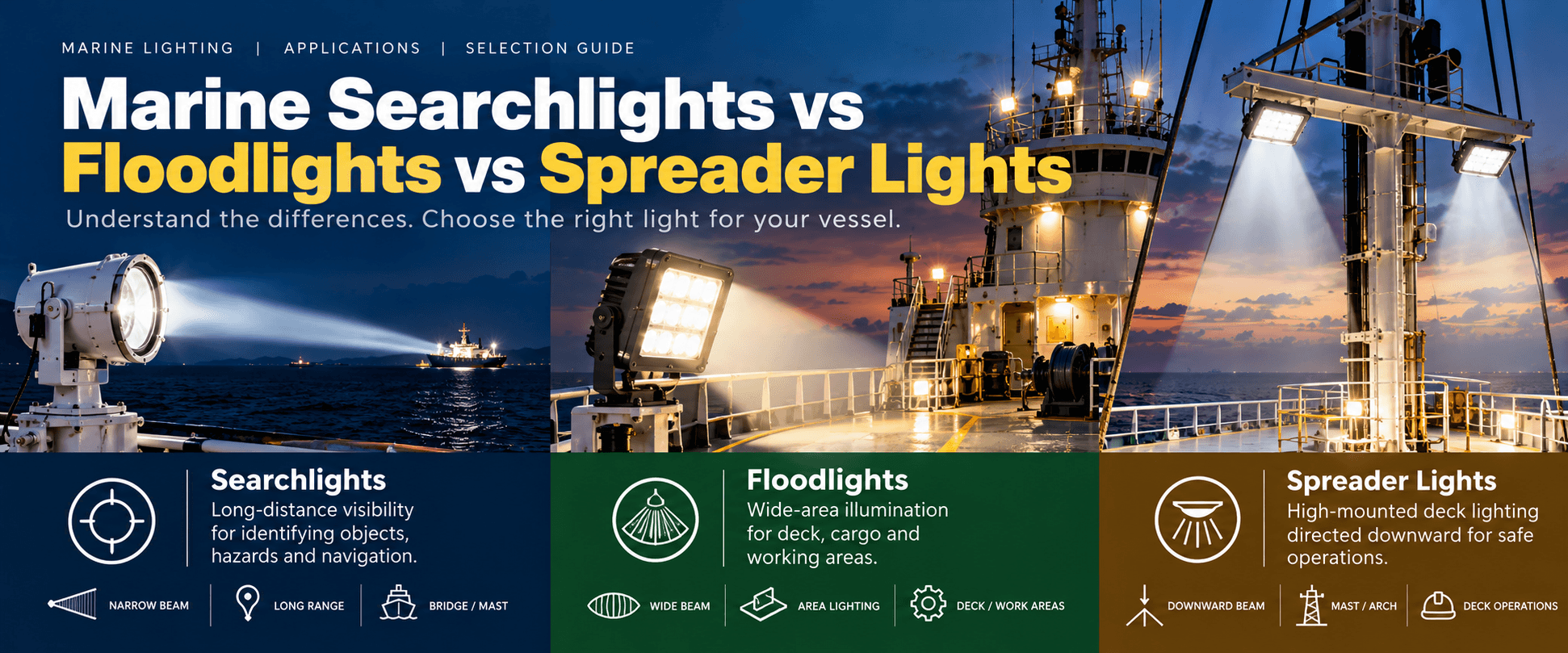
Yes. This is a good follow-on from the Navigation Lights and LED Spreader Lights articles. I’d make it a practical selection guide because the terms searchlight, floodlight, and spreader light are often confused, and in practice floodlight/spreader-light terminology can overlap. Seawell Industrial Engineering
Marine Searchlights vs Floodlights vs Spreader Lights: What’s the Difference?Suggested URL slug:/marine-searchlights-vs-floodlights-spreader-lights
SEO title:
Marine Searchlights vs Floodlights vs Spreader Lights | Selection Guide
Meta description:
Understand the difference between marine searchlights, floodlights and spreader lights. Compare beam patterns, applications, mounting positions and LED selection for ships and offshore vessels.
Choosing the Right Marine Deck Light
Ships and offshore vessels use several types of powerful exterior lighting, but searchlights, floodlights and spreader lights perform different jobs.
A searchlight is designed primarily to project a concentrated beam over a relatively long distance.
A floodlight distributes light across a much wider area.
A spreader light is generally an area/deck light installed at an elevated position and directed downward to illuminate the working deck below.
The terminology is not completely standardised. In particular, “floodlight,” “deck light” and “spreader light” can overlap between manufacturers. Seawell Industrial Engineering
For marine applications, it is therefore better to select a light according to its beam pattern, mounting position, output and intended task, rather than relying on the product name alone.
Searchlight vs Floodlight vs Spreader Light – Quick Comparison
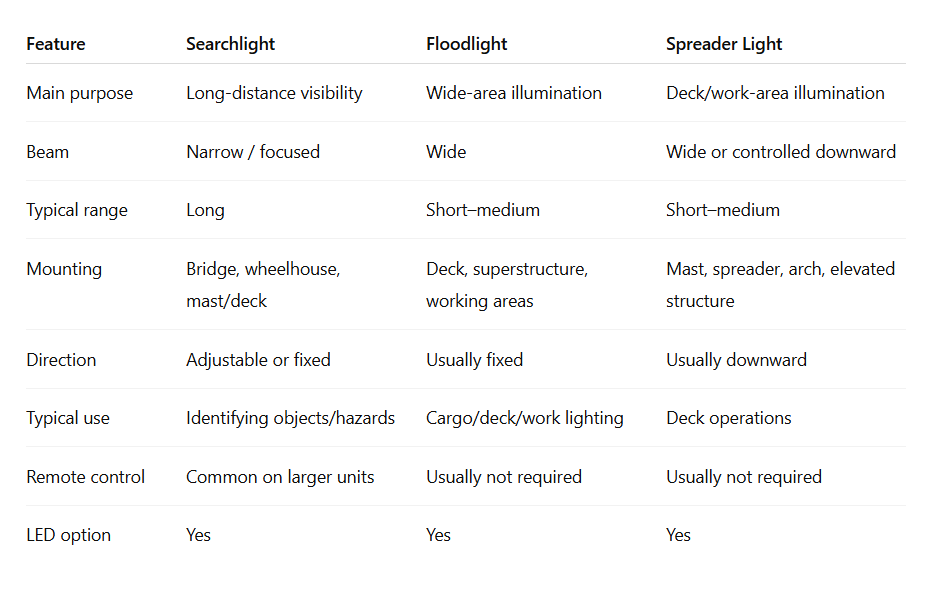
The important distinction is where you want the light to go.
1. What Is a Marine Searchlight?
A marine searchlight produces a powerful, concentrated beam designed to illuminate objects at a distance.
Rather than lighting an entire deck, a searchlight allows the operator to direct a relatively narrow beam toward a specific target.
Typical uses include:
identifying buoys and markers
locating objects in the water
identifying shoreline features
assisting search and rescue operations
inspecting nearby vessels
manoeuvring in dark areas
locating personnel or equipment
identifying hazards ahead
Searchlights may be manually controlled or remotely operated from the bridge.
Searchlight Beam – Distance Matters
For searchlights, lumens alone do not tell the whole story.
Lumens describe the total quantity of visible light produced, but a searchlight needs to concentrate that output into a relatively narrow beam.
For long-distance performance, beam intensity and beam distance are therefore particularly important.
Two lights could have similar lumen output but perform very differently:
Light A: wide beam → illuminates a large nearby area.
Light B: narrow concentrated beam → illuminates a smaller target much farther away.
Light B is much closer to what is normally required from a searchlight.
When comparing marine searchlights, therefore consider:
Beam angle
Candela / peak beam intensity
Effective beam distance
Lumen output
rather than lumens alone.
Remote-Controlled Marine Searchlights
Larger commercial vessels often use remote-controlled searchlights.
These allow the operator to rotate and tilt the light without leaving the bridge.
Depending on the model, functions may include:
horizontal rotation
vertical tilt
speed control
focus adjustment
ON/OFF control
home position
multiple control stations
Remote operation can be particularly valuable during harbour manoeuvring, offshore operations and search activities.
For replacement projects, the searchlight itself is only part of the system.
Compatibility with the existing control panel, power supply and cabling should also be checked.
2. What Is a Marine Floodlight?
A marine floodlight is designed to illuminate a broad area rather than a distant individual target.
The beam spreads outward, providing relatively even illumination over a working area.
Typical applications include:
main deck lighting
cargo deck illumination
mooring stations
loading areas
crane working areas
engine-room exterior areas
accommodation deck areas
offshore working decks
gangways
equipment inspection
A floodlight is therefore usually the better choice when the requirement is:
“I need to see the whole working area.”
rather than:
“I need to see an object far away.”
Searchlight vs Floodlight
This is the easiest distinction to remember:
Searchlight = Distance
A concentrated beam is directed toward a distant target.
Floodlight = Area
A broad beam illuminates a large nearby working area.
Imagine standing on the bridge of a vessel at night.
If you need to identify a buoy hundreds of metres ahead, you would typically use a searchlight.
If the crew needs to work safely across the aft deck, you would use floodlights.
3. What Is a Marine Spreader Light?
A spreader light is generally a deck or work light mounted above the area it illuminates.
The term originated from lights mounted around yacht mast spreaders, but it is now also used more broadly for elevated deck lights installed on structures such as:
masts
radar arches
hardtops
T-tops
wheelhouse roofs
deck structures
Their purpose is typically to direct broad illumination downward onto the deck or working area. DRSA - Light it up
Common applications include:
foredeck illumination
aft-deck illumination
line handling
mooring operations
fishing operations
equipment inspection
deck maintenance
nighttime working
Spreader Light vs Floodlight
This distinction can be confusing because a spreader light often is functionally a type of flood/deck light.
Some manufacturers even use the terms interchangeably. Black Oak LED
A useful practical distinction is:
Floodlight
Describes primarily the wide beam pattern.
Spreader Light
Describes primarily the application and mounting arrangement — generally an elevated light illuminating the deck below.
For example, an LED fixture mounted on the aft bulkhead and aimed outward across a working area might be described as a floodlight.
A similar wide-beam fixture mounted high on a mast and aimed downward onto the aft deck might be marketed as a spreader light.
Therefore, don't select a product purely because its catalogue says “spreader” or “flood.”
Look at the actual photometric performance and intended installation.
Beam Angle – One of the Most Important Specifications
Beam angle determines how concentrated or dispersed the light will be.
Conceptually:
Narrow beam → longer reach, smaller illuminated area
Wide beam → shorter reach, larger illuminated area
That is why searchlights generally use concentrated beams while flood and spreader lights use wider distributions.
For example:
Narrow Beam
Useful for:
searchlights
distant targets
markers
object identification
Medium Beam
Useful for:
targeted deck areas
cranes
loading areas
machinery
Wide Beam
Useful for:
working decks
mooring areas
general deck illumination
spreader-light applications
The exact beam angle should be selected from the manufacturer's photometric data rather than assuming a particular degree range from the product category.
Lumens vs Lux vs Candela
These terms are often confused when comparing marine lighting.
Lumens – Total Light Output
Lumens (lm) describe the total quantity of visible light emitted by the source.
This is useful, but does not tell you where the light goes.
Candela – Light Intensity
Candela (cd) describes luminous intensity in a particular direction.
This is especially relevant for searchlights, where concentrated beam intensity is important.
Lux – Light on a Surface
Lux (lx) describes illumination reaching a surface.
1 lux = 1 lumen per square metre.
Lux is particularly useful when evaluating deck and working-area illumination.
For example, when selecting a floodlight for a cargo working area, the important question isn't simply:
“How many lumens does the light produce?”
but also:
“How much usable illumination reaches the deck at the required mounting height and distance?”
Why Mounting Height Matters
Consider the same floodlight installed at two different heights.
Installed relatively low, it may produce strong illumination over a smaller area.
Installed much higher, it can cover a larger area, but the illumination reaching the deck may be reduced.
For this reason, professional marine-lighting selection should consider:
Mounting height
Mounting angle
Beam angle
Required coverage
Required lux level
Obstructions
Glare
This is where a manufacturer's photometric or lux distribution diagram becomes much more useful than simply comparing wattage.
LED vs Halogen vs Xenon
Marine searchlights and floodlights have traditionally used several lighting technologies.
Halogen
Halogen lamps have historically been common because they are relatively simple and provide immediate light output.
However, disadvantages can include:
higher power consumption
shorter lamp life
higher heat generation
periodic lamp replacement
Xenon
High-intensity xenon searchlights can produce powerful, concentrated beams suitable for long-distance applications.
They have traditionally been used where very high searchlight performance is required.
However, LED technology has increasingly become an alternative for many applications.
LED
Modern marine LED lighting offers several advantages:
lower power consumption
long service life
instant illumination
reduced maintenance
good vibration resistance
compact construction
lower heat load compared with many traditional sources
LED searchlights are increasingly used for commercial and recreational applications, while LED technology is particularly well suited to floodlights and spreader lights.
The appropriate technology still depends on required beam performance and operating conditions. Fisheries Supply
Selecting a Marine Searchlight
When selecting a searchlight, consider:
Beam Distance
How far must the operator be able to identify an object?
Beam Pattern
Is a narrow spot required, or would a combined spot/flood pattern be more useful?
Horizontal Rotation
Does the light need full or limited rotation?
Vertical Tilt
How far above and below horizontal must it move?
Control Method
Manual, local electric or remote bridge control?
Voltage
Common vessel systems can include:
12 V DC
24 V DC
110/115 V AC
220/230 V AC
Check the exact vessel supply.
Environmental Protection
Check:
IP rating
corrosion resistance
vibration resistance
operating temperature
saltwater exposure
Approval
For commercial or safety-related applications, check the vessel/project's required class or type approval.
Selecting a Marine Floodlight
For floodlights, the priorities are somewhat different.
Consider:
Required deck area
How large an area needs illumination?
Mounting height
How far is the fixture from the working surface?
Required illumination
What lux level is needed at deck level?
Beam distribution
Wide, medium or asymmetric?
Glare
Could the light interfere with bridge visibility or crew working nearby?
Colour temperature
Different colour temperatures can affect visual comfort and contrast.
IP rating
Exterior deck lights should be suitable for their exposure to water and weather.
Construction
Housing and mounting materials should suit the corrosive marine environment.
Selecting a Marine Spreader Light
For spreader/deck-light applications, consider:
Mounting position
Mast, arch, wheelhouse, hardtop or another elevated structure?
Direction
Does the light need to illuminate directly downward or outward?
Coverage
Foredeck, aft deck, mooring station or entire work area?
Glare control
A poorly positioned high-output spreader light can cause significant glare.
Beam pattern
Choose a beam that illuminates the required area without wasting excessive light over the water or toward the bridge.
Avoiding Glare on the Bridge
More light is not always better.
Poorly positioned deck floodlights can reflect from:
white deck surfaces
stainless steel
windows
railings
wet surfaces
and impair the crew's night vision.
Searchlights can create an even greater problem if reflected from nearby structures or operated unnecessarily toward another vessel.
Good marine-lighting design therefore requires controlled light, not simply maximum brightness.
Searchlights Are Not Navigation Lights
This is particularly important following our previous Marine Boys guide.
A searchlight, floodlight or spreader light does not replace a navigation light.
Navigation lights have specific requirements covering colour, sector, visibility and positioning under COLREGs. IMO's COLREG material identifies Rules 21–31 as covering definitions, visibility and required navigation-light configurations for different vessel operations. International Maritime Organization
A searchlight is supplementary equipment used to illuminate an object or area.
The two functions should not be confused.
Strong deck or search lighting should also be installed and operated so that it does not make the vessel's required navigation lights difficult to distinguish or unnecessarily impair visibility.
Searchlights for Lifeboats and Rescue Boats
Searchlights can also have a specific safety role.
IMO's testing recommendations include dedicated provisions for searchlights for lifeboats and rescue boats, including marking, electrical protection, battery recharging where applicable, replaceable illuminants and construction considerations. IMO
Therefore, a searchlight intended as part of regulated lifesaving equipment should not automatically be substituted with an ordinary commercial spotlight simply because it appears to have similar brightness.
The applicable equipment requirements and approval should be checked.
Marine Searchlight, Floodlight & Spreader Light Selection Checklist
Before requesting a quotation, confirm:
1. Application
Search, deck work, mooring, cargo handling, rescue or general illumination?
2. Light type
Searchlight, floodlight or spreader/deck light?
3. Required beam
Narrow, medium or wide?
4. Required range or coverage
Long-distance target or broad working area?
5. Mounting position
Bridge, mast, deck, bulkhead, spreader or wheelhouse?
6. Supply voltage
DC or AC, voltage and frequency.
7. LED / Halogen / Xenon
Is a particular technology required?
8. Environmental rating
IP rating, corrosion resistance and operating temperature.
9. Control
Fixed, manual or remotely controlled?
10. Approval
Does the vessel or project require specific marine/class approval?
Replacing an Existing Marine Light
When replacing an existing searchlight or floodlight, provide a clear photograph of the nameplate wherever possible.
Useful information includes:
Manufacturer
Model / Part number
Voltage / Frequency
Wattage
Lamp type
Beam specification
IP rating
Mounting type
Class/type approval
Control-unit model
For a remote-controlled searchlight, photographs of the existing controller and wiring information can also help identify a suitable replacement.
Daeyang Marine Searchlights & Floodlights
Daeyang Electric is a Korean manufacturer of marine lighting and electrical equipment used in shipbuilding and marine applications.
For Marine Boys, I would keep this section commercial but concise:
Marine Boys supplies Daeyang marine lighting equipment for vessel maintenance, shipbuilding and replacement projects in Australia. Our marine lighting range includes searchlights, floodlights, deck lighting and other specialised shipboard lighting equipment.
For replacement enquiries, send us the existing manufacturer/model, nameplate photo, voltage, required beam/application and quantity so we can assist in identifying a suitable option.
This is a natural place to add actual Daeyang searchlight and floodlight product images and links to your relevant product pages.
Need Help Choosing the Right Marine Light?
Choosing between a searchlight, floodlight and spreader light becomes much easier when you start with the application:
Need to identify something far away? → Searchlight
Need to illuminate a large working area? → Floodlight
Need overhead illumination directed onto the deck? → Spreader light
Marine Boys can assist with sourcing marine and offshore lighting for commercial vessels, shipyards and maintenance projects.
For faster identification, send:
Application
Existing model/nameplate
Voltage
Mounting location
Required beam or coverage
Required approval
Quantity
Marine Searchlights vs Floodlights vs Spreader Lights | Selection Guide

Understand the difference between marine searchlights, floodlights and spreader lights. Compare beam patterns, applications, mounting positions and LED selection for ships and offshore vessels.

Read more → https://www.marineboys.com.au/blog/marine-searchlights-vs-floodlights-spreader-lights

Marine Searchlights, Marine Floodlights, Marine Spreader Lights, Marine Lighting, LED Marine Lighting, Marine Deck Lighting, Ship Lighting, Offshore Lighting, Marine Electrical Equipment, Daeyang
Copy the caption, click Open LinkedIn, paste, and attach the cover image.