6 October 2026 · Marine Boys
Marine Navigation Lights | COLREG Requirements & LED Selection Guide
A practical guide to marine navigation lights covering COLREG requirements, masthead, sidelight, stern and all-round lights, visibility ranges, LED selection and marine approvals.
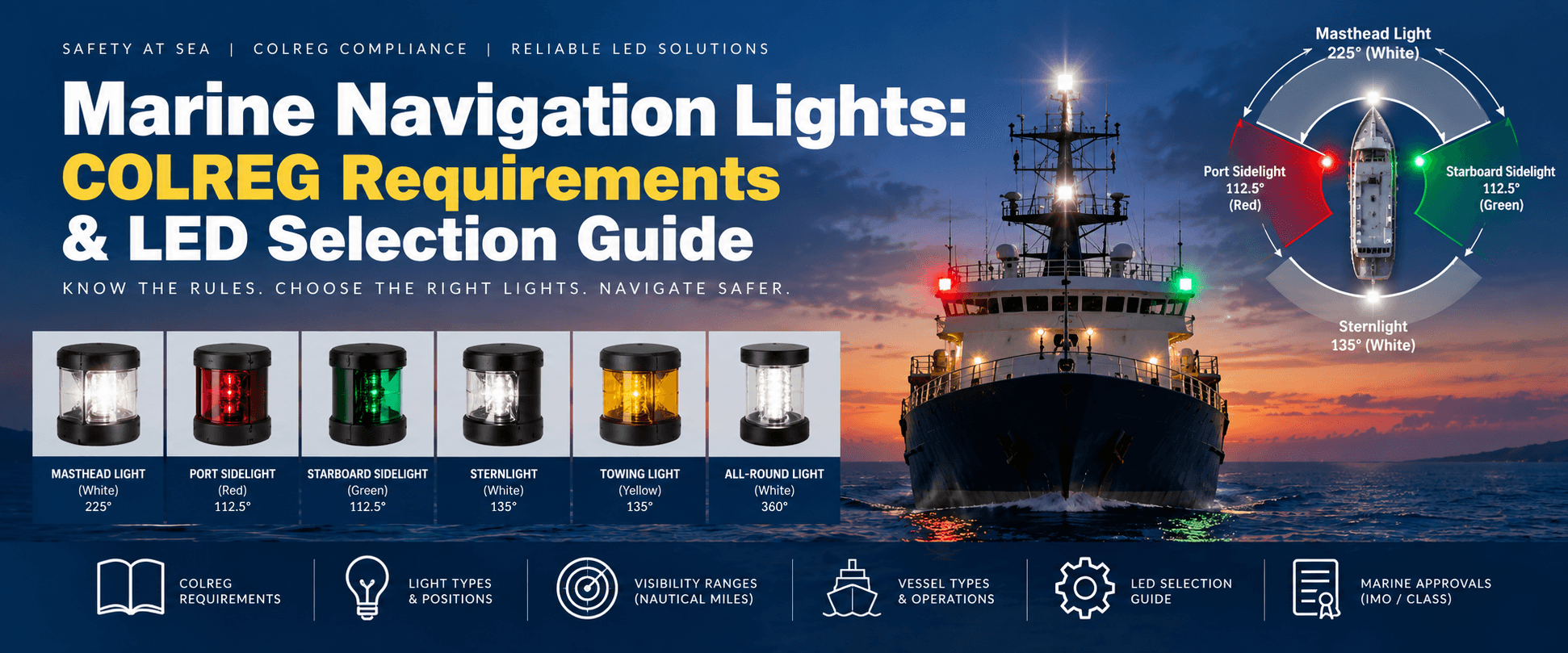
What Are Marine Navigation Lights?
Marine navigation lights are essential safety equipment that allow vessels to identify each other's direction of travel, size, activity and operational status, particularly at night and in restricted visibility.
Navigation lights are not simply general-purpose marine lights. Their colour, visibility arc, luminous intensity, positioning and minimum visibility range are governed by the International Regulations for Preventing Collisions at Sea, commonly known as COLREGs.
COLREG Part C covers lights and shapes. Rule 20 deals with their application, Rule 21 defines the principal navigation lights, Rule 22 establishes minimum visibility ranges, and Rules 23–31 specify the lights required for different vessel types and operating conditions. International Maritime Organization
For shipowners, shipyards and marine engineers, selecting a replacement LED navigation light therefore involves much more than matching the voltage and colour.
Main Types of Marine Navigation Lights
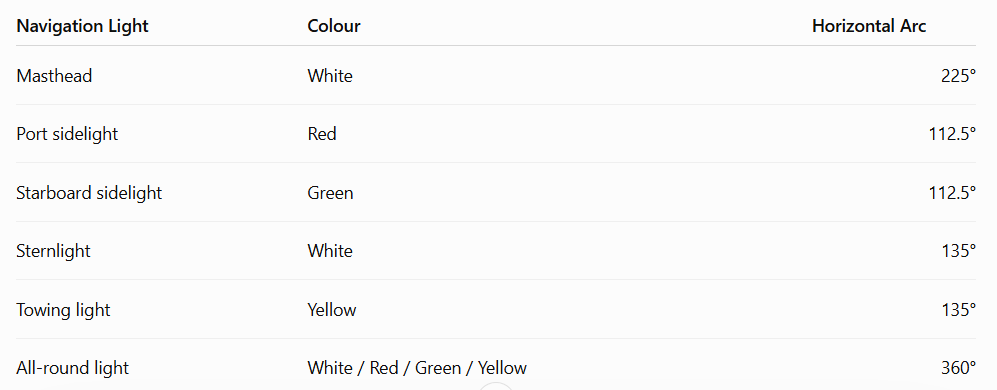
Under COLREG Rule 21, the principal navigation lights include masthead lights, sidelights, sternlights, towing lights and all-round lights. Australian Maritime Safety Authority
Masthead Light
A white light positioned over the vessel's fore-and-aft centreline.
It displays an uninterrupted light over an arc of:
225°
The light is visible from directly ahead to 22.5° abaft the beam on each side. Australian Maritime Safety Authority
Masthead lights are particularly important for identifying power-driven vessels underway.
Port Sidelight
The port sidelight is:
Red – 112.5°
It shows from directly ahead to 22.5° abaft the beam on the port side. Australian Maritime Safety Authority
Starboard Sidelight
The starboard sidelight is:
Green – 112.5°
It covers the equivalent sector on the starboard side. Australian Maritime Safety Authority
On vessels less than 20 metres long, COLREGs allow the port and starboard sidelights to be combined in a single lantern carried on the fore-and-aft centreline. Australian Maritime Safety Authority
Sternlight
The sternlight is a white light positioned as nearly as practicable at the stern.
Its horizontal arc is:
135°
This covers 67.5° from directly astern on each side. Australian Maritime Safety Authority
All-Round Light
An all-round light displays an uninterrupted light through:
360°
Depending on the vessel's status and application, an all-round light may be white, red, green or yellow.
Towing Light
A towing light is yellow and has the same 135° arc as a sternlight. Australian Maritime Safety Authority
It is used as part of the light configurations specified for towing operations under COLREG Rule 24.
Quick Navigation Light Reference
When Must Navigation Lights Be Displayed?
COLREG Rule 20 requires the prescribed lights to be displayed from sunset to sunrise.
The prescribed lights must also be exhibited during daytime when visibility is restricted, and they may be shown in other circumstances when considered necessary. Australian Maritime Safety Authority
This means navigation lights are important not only for nighttime operation but also in conditions such as:
fog
heavy rain
sea mist
smoke
other conditions of restricted visibility
COLREG Navigation Light Visibility Requirements
Correct colour and arc are not enough.
Rule 22 also specifies the minimum range at which navigation lights must be visible, depending on vessel length and the type of light. International Maritime Organization
For example, for vessels 50 metres or more in length, the required minimum ranges include:
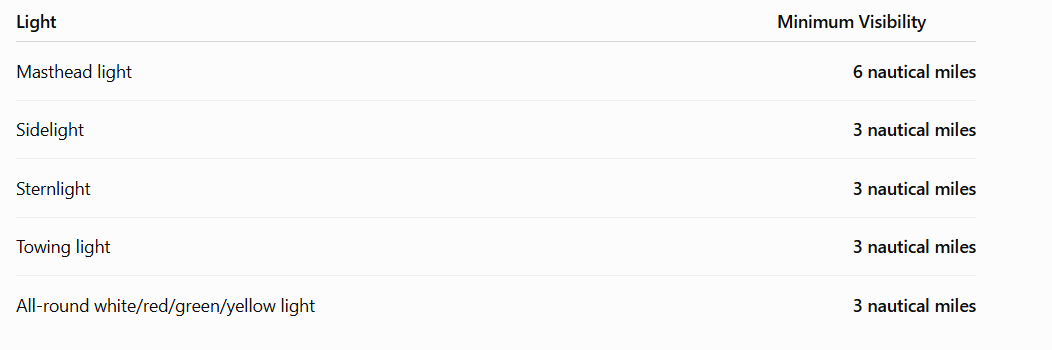
Smaller vessels have different minimum visibility requirements.
This is why a navigation light should not be selected simply because it is described as "bright" or has a high lumen output.
A compliant navigation light must provide the required luminous intensity, colour and angular distribution for its intended application.
Navigation Lights for a Power-Driven Vessel Underway
COLREG Rule 23 establishes the lights required for power-driven vessels underway. International Maritime Organization
A conventional arrangement can include:
Forward masthead light – White
Second masthead light – White
where required by vessel size
Port sidelight – Red
Starboard sidelight – Green
Sternlight – White
The exact configuration depends on factors including the vessel's length and operation.
For this reason, when replacing navigation lights on an existing vessel, the safest approach is usually to work from the vessel's approved navigation light arrangement rather than selecting lights independently.
AMSA notes that vessels required to comply with Part C of COLREGs should have navigation-light arrangement information showing details such as light types, visibility ranges, horizontal and vertical positions and spacing. Australian Maritime Safety Authority
Navigation Lights Communicate Vessel Status
Navigation lights do much more than indicate which direction a vessel is travelling.
Different combinations communicate the vessel's activity or status.
COLREGs contain specific requirements for:
Power-driven vessels – Rule 23
Towing and pushing vessels – Rule 24
Sailing vessels – Rule 25
Fishing vessels – Rule 26
Vessels not under command – Rule 27
Vessels restricted in their ability to manoeuvre – Rule 27
Vessels constrained by draught – Rule 28
Pilot vessels – Rule 29
Vessels at anchor or aground – Rule 30. International Maritime Organization
For example, combinations of red, white and green all-round lights can indicate very different vessel operations.
Consequently, the location, colour and sequence of navigation lights must not be changed casually.
Why Are LED Navigation Lights Now Common?
LED technology has largely replaced traditional incandescent lamps in many modern marine lighting applications.
Advantages can include:
lower power consumption
long operating life
reduced maintenance
compact construction
good vibration resistance
reduced heat generation
improved reliability
These benefits are particularly attractive on vessels where access to mast-mounted navigation lights can be difficult.
However, being LED does not automatically make a light suitable as a COLREG navigation light.
The complete navigation light needs to meet the applicable performance requirements.
LED Navigation Lights – An Important Requirement
LEDs behave differently from conventional lamps.
AMSA points out that LED luminous intensity can gradually decline during service even though electrical consumption may remain essentially unchanged. Australian Maritime Safety Authority
For navigation lights, this is important because a lamp might still appear to be working while no longer producing the luminous intensity required by COLREGs.
IMO Resolution MSC.253(83) therefore establishes performance standards for navigation lights, navigation-light controllers and associated equipment.
For LED navigation lights, AMSA highlights two approaches to addressing declining luminous intensity:
1. Monitoring
An alarm can warn the Officer of the Watch if luminous intensity falls below the required level.
or
2. Defined LED service life
The LED navigation light is used only within the manufacturer's specified practical term of validity established to maintain the required luminous intensity. Australian Maritime Safety Authority
This is an important point when replacing older navigation lights with LED models.
What Should You Check When Selecting an LED Navigation Light?
When requesting or selecting a replacement navigation light, consider the following.
1. Type of Navigation Light
Identify whether you require:
masthead
port sidelight
starboard sidelight
sternlight
towing light
all-round light
special-purpose navigation light
Do not rely only on the physical appearance of the existing fitting.
2. Vessel Length
The vessel's length can affect:
required visibility range
light arrangement
number of lights
installation position
A navigation light suitable for a small workboat may therefore not be suitable for a 100-metre commercial vessel.
3. Required Visibility Range
Confirm the required range in nautical miles.
For example:
3 NM, 5 NM or 6 NM
depending on light type, vessel length and application.
4. Horizontal Arc
Confirm the required sector:
112.5° / 135° / 225° / 360°
A white 225° masthead light and a white 135° sternlight may appear similar when switched off, but they perform completely different navigational functions.
5. Colour
Navigation light colours are tightly controlled.
Typical requirements include:
White
Red
Green
Yellow
The colour needs to meet the applicable chromaticity requirements; simply installing a coloured LED or coloured lens is not enough to establish compliance.
6. Supply Voltage
Common marine electrical systems may use:
24 V DC
110/115 V AC
220/230 V AC
or other vessel-specific supplies.
Confirm both voltage and frequency where applicable.
7. Environmental Protection
Navigation lights are exposed to some of the harshest conditions aboard a vessel.
Check the manufacturer's specification for:
IP rating
saltwater resistance
corrosion resistance
vibration
ambient temperature
UV/weather exposure
The exact requirements will depend on installation location and vessel type.
8. Marine Type Approval
For commercial marine applications, check the actual approval required by the vessel, owner, flag administration or classification society.
Depending on the project, documentation may include approval from organisations such as:
DNV / ABS / Lloyd's Register / Bureau Veritas / RINA / Korean Register
Do not assume that a general-purpose "marine grade" light is an approved navigation light.
IMO MSC.253(83) and Navigation Lights
IMO Resolution MSC.253(83) sets performance standards for navigation lights, navigation-light controllers and associated equipment.
AMSA specifically references MSC.253(83) in its Australian navigation-light guidance and recommends checking valid type-approval certificates, installation instructions and LED expiry/service-life information. Australian Maritime Safety Authority
For LED navigation lights, the manufacturer's documentation is therefore particularly important.
When purchasing replacement equipment, ask for the exact:
Model number
Type approval certificate
Visibility range
Light sector
Voltage
LED lifetime / validity information
rather than selecting a fitting only from photographs.
Navigation Light Controllers
On larger vessels, individual navigation lights are commonly integrated into a navigation light control and monitoring system.
The system can provide:
ON/OFF control
lamp status indication
failure alarms
power failure alarms
main/emergency supply monitoring
bridge indication
When replacing an individual navigation light, compatibility with the existing controller should therefore be checked.
Important factors can include:
Voltage
Current/load characteristics
Failure monitoring method
LED compatibility
Alarm circuit
Existing manufacturer/system
Replacing an incandescent navigation light with an LED unit can sometimes affect a monitoring system if the electrical characteristics differ.
LED Lights and Radio Interference
Another factor worth considering on vessels is electromagnetic compatibility.
AMSA has warned that some LED lighting equipment can potentially interfere with VHF marine radio, DSC and AIS reception. Australian Maritime Safety Authority
Navigation lights are often installed high on the vessel, sometimes near antennas and other communications equipment.
For marine installations, selecting properly tested equipment and following the manufacturer's installation requirements is therefore important.
Navigation Lights in Australia
In Australia, Marine Order 30 (Prevention of collisions) 2016 implements collision-prevention requirements and covers the lights and signals used by vessels. Australian Maritime Safety Authority
For domestic commercial vessels, the current NSCV navigation-equipment requirements reference the performance standards for navigation lights contained in Marine Order 30. Australian Maritime Safety Authority
Owners and operators should therefore check the requirements applicable to their specific vessel rather than assuming that the same navigation-light arrangement applies to every vessel.
AMSA – Marine Order 30: Prevention of Collisions
Replacing an Existing Marine Navigation Light
For replacement projects, one of the easiest ways to avoid specification errors is to provide the supplier with a clear photograph of the existing nameplate.
Ideally, provide:
Manufacturer
Model number
Part number
Light type
Colour
Visibility range
Horizontal arc
Supply voltage
Wattage
Approval information
Vessel name/type and length
If the original model is obsolete, these details make it much easier to identify an appropriate modern equivalent.
Example: Replacing a Masthead Light
Suppose a vessel has an older conventional masthead light that needs replacement.
Simply asking for:
"White LED navigation light, 24 V"
is not enough.
A better enquiry would be:
LED Masthead Navigation Light
White
225°
24 V DC
Required visibility: 6 NM
IMO/COLREG compliant
Marine type approval required
Existing model/nameplate attached
This dramatically reduces the risk of receiving the wrong light.
Marine Navigation Light Selection Checklist
Before ordering, confirm:
✓ Vessel type
✓ Vessel length
✓ Navigation light function
✓ Colour
✓ Horizontal arc
✓ Required visibility range
✓ Supply voltage/frequency
✓ LED or conventional lamp
✓ IP/environmental rating
✓ Required marine/class approval
✓ Navigation light controller compatibility
✓ Existing manufacturer/model
✓ Mounting arrangement
For replacement equipment, always provide the existing nameplate and installation photographs where possible.
Daeyang Marine LED Navigation Lights
Daeyang Electric is a Korean manufacturer of marine electrical and lighting equipment used across shipbuilding and offshore applications.
For Marine Boys, I would use this section to introduce your Daeyang navigation-light range, but keep it relatively short so the article remains educational rather than becoming a product advertisement.
A suitable paragraph would be:
Marine Boys supplies Daeyang marine lighting and electrical equipment for shipbuilding, vessel maintenance and replacement projects in Australia. For navigation-light enquiries, provide the existing model/nameplate, vessel details, voltage and required approval so that the appropriate product can be identified.
You can then place a Daeyang navigation-light product image or product-category link immediately below this section.
Need Help Identifying a Marine Navigation Light?
Marine Boys can assist with sourcing marine LED navigation lights and replacement marine lighting equipment for commercial vessels, offshore applications and ship maintenance projects.
For faster identification, send us:
Photo of existing nameplate
Manufacturer & model
Vessel length
Light type and colour
Voltage
Required visibility range
Required class/type approval
Quantity
We can then assist in identifying suitable replacement options.
Marine Navigation Lights | COLREG Requirements & LED Selection Guide

A practical guide to marine navigation lights covering COLREG requirements, masthead, sidelight, stern and all-round lights, visibility ranges, LED selection and marine approvals.

Read more → https://www.marineboys.com.au/blog/marine-navigation-lights-colreg-led-selection-guide

#MarineNavigationLights #COLREG #MarineLighting #LEDLighting #MarineSafety #MarineEngineering #Shipbuilding #MaritimeIndustry #MarineElectrical #Daeyang #MarineBoys
Copy the caption, click Open LinkedIn, paste, and attach the cover image.