5 October 2026 · Marine Boys
Marine Cable Selection Guide | Power vs Control vs Instrumentation Cable
Learn the differences between marine power, control and instrumentation cables, including construction, voltage, shielding, fire performance and how to select the correct shipboard cable.
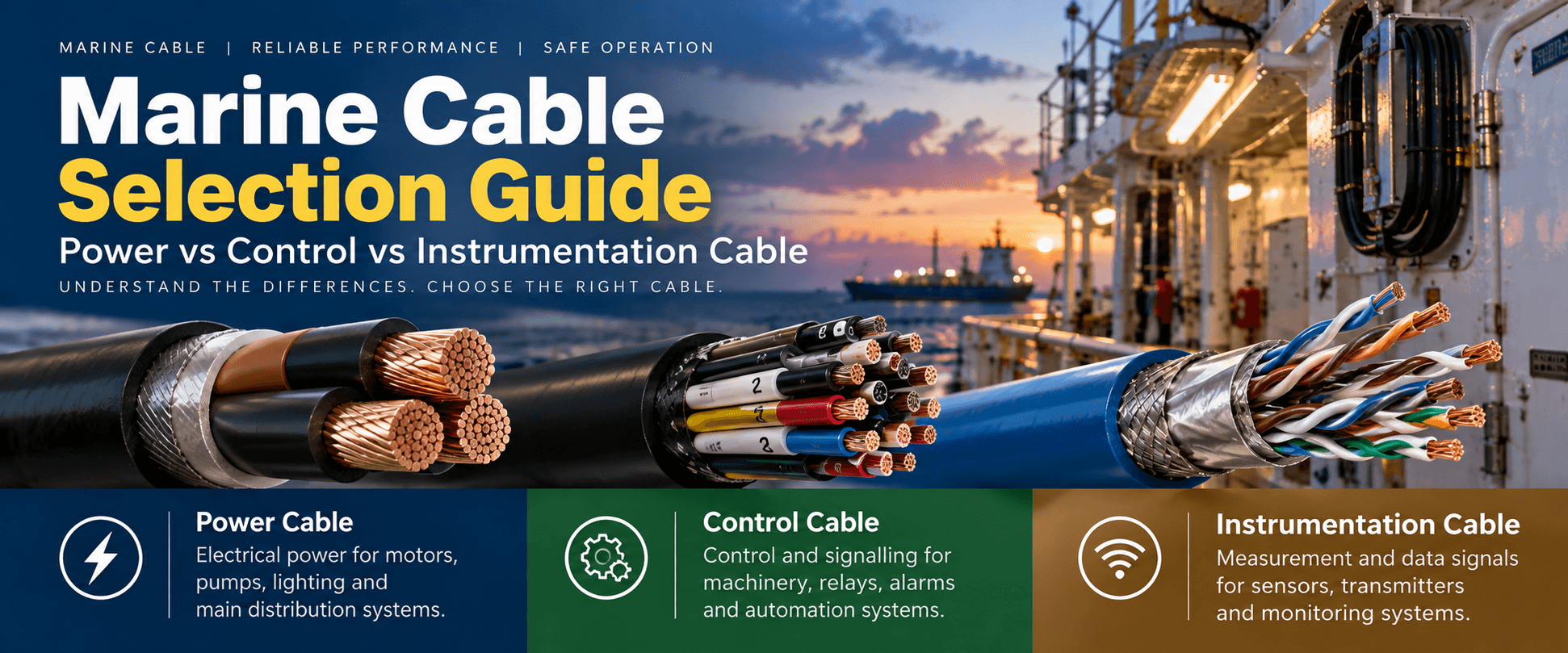
Choosing the Right Marine Cable
Electrical cables on ships and offshore installations perform very different functions.
Some cables carry power to motors, pumps and distribution boards. Others transmit control signals between machinery and automation systems. Instrumentation cables may carry low-level analogue or digital signals where electromagnetic interference can affect measurement accuracy.
Selecting the wrong cable can lead to problems ranging from unreliable signals and electromagnetic interference to premature cable failure or non-compliance with project requirements.
Three of the most common categories are:
Power cables – distribute electrical power
Control cables – transmit operational and control signals
Instrumentation cables – transmit measurement and low-level signals
Although their construction can sometimes appear similar, their intended applications can be very different.
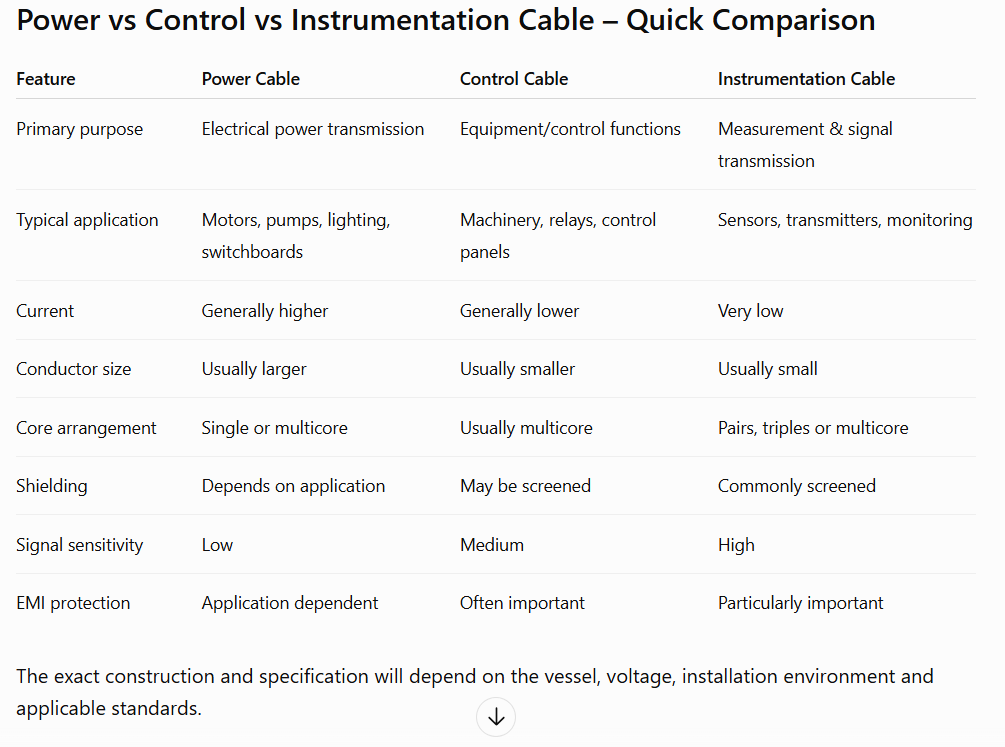
1. What Is Marine Power Cable?
Marine power cables are designed primarily to carry electrical energy from one part of the vessel or offshore installation to another.
Typical applications include:
main and emergency switchboards
distribution boards
electric motors
pumps
compressors
ventilation systems
deck machinery
lighting circuits
generators
transformers
Power cables generally carry substantially more current than control or instrumentation cables.
For this reason, conductor cross-sectional area is a critical part of cable selection.
Common conductor sizes can range from relatively small lighting and auxiliary circuits to large cables supplying high-power motors and distribution systems.
Low-Voltage Marine Power Cables
Many shipboard power distribution applications use cables rated around 0.6/1 kV, although the required voltage rating depends on the electrical system and cable specification.
Typical constructions may include:
Copper conductor → insulation → fillers/bedding → screen or armour where required → outer sheath
Marine cables often use stranded copper conductors to provide flexibility and withstand vibration.
Depending on the specification, conductors may also be tinned copper, which can offer additional corrosion resistance in marine environments.
2. What Is Marine Control Cable?
Control cables are used to transmit electrical signals that operate or control equipment rather than supply the main operating power.
For example, a motor may receive its electrical power through a large power cable, while a smaller multicore control cable connects the motor control system to switches, relays, contactors or the vessel automation system.
Typical applications include:
motor starters
control panels
relay circuits
alarm systems
valve controls
pump controls
machinery automation
remote start/stop circuits
interlocks
indication circuits
Control cables commonly contain multiple relatively small conductors within one cable.
A cable might therefore contain 4, 7, 12, 19 or more cores depending on the system.
3. What Is Marine Instrumentation Cable?
Instrumentation cables are designed primarily for the transmission of measurement, monitoring and low-level electrical signals.
Typical applications include:
temperature sensors
pressure transmitters
level measurement
flow meters
process instrumentation
monitoring systems
alarm systems
automation systems
data acquisition equipment
Because these signals can be relatively small, they may be more susceptible to electromagnetic interference (EMI).
Instrumentation cable construction therefore often places greater emphasis on screening and conductor arrangement.
Why Are Instrumentation Cables Often Twisted?
Instrumentation cables frequently use twisted pairs or triples.
Twisting the conductors helps reduce the effect of external electromagnetic interference and can improve signal integrity.
A typical instrumentation cable might therefore be described as:
1 pair × 1.5 mm²
or
12 pairs × 1.5 mm²
rather than simply being specified as a conventional multicore cable.
Some instrumentation systems use triples instead of pairs depending on the measurement or circuit design.
Overall Screen vs Individual Screen
This is an important distinction when selecting instrumentation cable.
Overall Screen
All pairs or cores are protected by a common screen surrounding the complete cable assembly.
A simplified construction might look like:
Pairs → Overall Screen → Outer Sheath
This can provide protection against external electromagnetic interference.
Individual + Overall Screen
Each pair may have its own individual screen, with an additional overall screen around all pairs.
For example:
Pair → Individual Screen
Pair → Individual Screen
Pair → Individual Screen
followed by:
Overall Screen → Outer Sheath
Individual screening can help reduce interference or crosstalk between separate signal circuits.
This can be important in sensitive instrumentation and automation applications.
Power Cable vs Control Cable
A common question is:
Can a control cable be used as a power cable?
Cable selection should be based on the manufacturer's cable designation, voltage rating, conductor size, current-carrying capacity, installation method, applicable standard and approval, rather than simply the physical appearance of the cable.
A control cable may have sufficient voltage rating for a particular circuit but still not be the correct cable for a power application.
Similarly, using an oversized power cable for a control or signal circuit does not necessarily make it technically appropriate.
The intended cable application matters.
Control Cable vs Instrumentation Cable
Control and instrumentation cables can look particularly similar because both often contain small conductors.
The major difference is their function and signal requirements.
Control cables commonly transmit commands such as:
START / STOP / OPEN / CLOSE / ON / OFF
Instrumentation cables typically transmit information such as:
Temperature / Pressure / Level / Flow / Position
Instrumentation signals can be much more sensitive to interference, making cable geometry and screening particularly important.
Why Cable Screening Matters
Ships and offshore facilities contain many potential sources of electromagnetic interference, including:
generators
electric motors
variable-frequency drives (VFDs)
transformers
radio equipment
switching equipment
high-current power cables
Running a sensitive instrumentation cable near these sources can introduce unwanted electrical noise into the signal.
Appropriate screening, cable segregation, routing and termination practices can therefore be critical.
Cable selection should form part of the overall EMC design of the installation, rather than treating the cable as an isolated component.
Flame Retardant vs Fire Resistant Marine Cable
Another important distinction is between flame-retardant and fire-resistant cables.
These terms should not be treated as interchangeable.
Flame-Retardant Cable
Flame-retardant cable is designed to limit the propagation of fire along the cable.
Fire-Resistant Cable
Fire-resistant cable is designed to maintain circuit integrity for a specified period under defined fire conditions.
Fire-resistant cables may be required for critical or emergency systems such as:
emergency lighting
fire detection and alarm
emergency shutdown systems
essential communication
critical control circuits
The exact requirement depends on the vessel, system, classification rules and project specification.
Marine Boys covers this subject separately in our Fire Resistant vs Flame Retardant Marine Cables guide.
What Does LSHF Mean?
LSHF means Low Smoke Halogen Free.
You may also encounter similar terminology such as LSZH or SHF depending on the applicable specification and manufacturer.
The objective is to reduce smoke and corrosive/halogen-containing gases generated during fire conditions compared with conventional halogenated cable materials.
This is particularly relevant aboard ships because cables often run through enclosed spaces occupied by crew and passengers.
Marine cable specifications can therefore include requirements relating to:
flame propagation
smoke density
halogen gas emissions
fire resistance
circuit integrity
These requirements need to be checked individually rather than assuming that one fire-performance designation covers all of them.
IEC 60092 Standards for Marine Cables
The IEC 60092 series covers electrical installations in ships.
For marine cable selection, important standards include IEC 60092-350, which provides general construction and test requirements for shipboard and offshore power, control and instrumentation cables, and IEC 60092-376, which covers shipboard and offshore control and instrumentation cables.
IEC 60092-350 – IEC official page
IEC 60092-376 – IEC official page
The exact standards applicable to a cable should always be checked against the manufacturer's documentation and project specification.
What About NEK 606 Offshore Cable?
For offshore oil & gas applications, NEK 606 is another specification frequently encountered.
Offshore cables may require characteristics beyond those of conventional shipboard cables, including resistance to:
hydrocarbons
drilling fluids
oils
mud
UV exposure
harsh environmental conditions
mechanical stresses
Common offshore cable designations include products such as RFOU and BFOU, depending on cable construction and application.
These should not simply be considered interchangeable with ordinary marine cable.
Marine Boys covers offshore cable requirements separately in our O-Route® NEK-606 Offshore Cable Guide.
Armoured vs Unarmoured Marine Cable
Another important selection question is whether the cable requires mechanical protection or armour.
Depending on the cable system and specification, marine cables may incorporate metallic braid or other protective constructions.
Armour or braid can provide benefits such as:
Mechanical protection
Protection against damage during installation and operation.
EMC performance
Certain metallic constructions can contribute to electromagnetic screening when correctly designed and terminated.
The correct requirement depends on the installation location, cable construction, project specification and class requirements.
How to Select the Correct Marine Cable
When requesting a marine cable quotation, providing only:
"Need marine cable 3 × 2.5 mm²"
is often insufficient.
A more complete specification should consider:
1. Application
Power, control, instrumentation, communication or another function?
2. Voltage rating
What system voltage will the cable operate at?
3. Number of cores / pairs / triples
For example, 3C, 7C, 12 pair or 4 triple.
4. Conductor size
For example, 1.5 mm², 2.5 mm², 6 mm² or 50 mm².
5. Conductor material
Copper or tinned copper, as required.
6. Screening
Unscreened, overall screened or individually + overall screened?
7. Fire performance
Is flame retardancy, fire resistance or specific smoke/halogen performance required?
8. Mechanical protection
Is armour or braid required?
9. Environmental requirements
Will the cable be exposed to oil, mud, hydrocarbons, sunlight, weather or other harsh conditions?
10. Standard
IEC 60092, NEK 606 or another project-specific standard?
11. Classification approval
Is approval from DNV, ABS, LR, BV, RINA, KR or another classification society required?
12. Quantity
What total cable length is required?
Reading a Marine Cable Specification
A typical request might read:
0.6/1 kV – 3C × 6 mm² – tinned copper – XLPE insulated – LSHF – armoured – IEC 60092
From this description, the supplier can identify several important characteristics:
0.6/1 kV → voltage rating
3C → three conductors/cores
6 mm² → conductor cross-sectional area
Tinned copper → conductor construction
XLPE → insulation material
LSHF → low-smoke/halogen-free characteristics
Armoured → mechanical/protective construction
IEC 60092 → marine electrical standard family
However, even this may not be enough to select the exact product.
The applicable IEC part, fire-performance requirements, approvals, installation conditions and manufacturer's cable designation may still need to be confirmed.
Example: Selecting Cable for a Marine Pump
Consider an electric seawater pump.
The installation might require three different cable types.
Power cable
Carries electrical power from the switchboard or motor starter to the pump motor.
Control cable
Carries start/stop, status, interlock or alarm signals between the motor control system and other equipment.
Instrumentation cable
May carry signals from pressure, temperature or flow sensors associated with the pump system.
All three cables may be installed around the same equipment, but each performs a fundamentally different job.
This is why cable selection should start with what the circuit does, not simply conductor size.
Marine Cable Selection Checklist
Before placing an order, confirm:
✓ Cable application
✓ Voltage rating
✓ Number of cores/pairs
✓ Conductor size
✓ Screen requirement
✓ Fire performance
✓ Armour/braid requirement
✓ Operating environment
✓ Applicable IEC/NEK standard
✓ Classification approval
✓ Manufacturer/model preference
✓ Required length
If replacing an existing marine cable, providing a clear photograph of the cable sheath marking can be extremely useful.
The printed marking often identifies the manufacturer, cable designation, voltage, size, standard and approval information.
Marine & Offshore Cable Supply in Australia
Marine Boys supplies marine and offshore electrical cables for vessel maintenance, shipbuilding, offshore projects and industrial marine applications.
Our sourcing capabilities include:
marine power cables
marine control cables
instrumentation cables
LSHF marine cables
fire-resistant cables
offshore cables
NEK 606 cables
screened and armoured cables
Korean marine cable manufacturers
We can assist customers in identifying suitable cable based on an existing cable marking, technical specification or project requirement.
Marine Cable Selection Guide | Power vs Control vs Instrumentation Cable

Learn the differences between marine power, control and instrumentation cables, including construction, voltage, shielding, fire performance and how to select the correct shipboard cable.

Read more → https://www.marineboys.com.au/blog/marine-cable-selection-power-control-instrumentation

#MarineCable #MarineElectrical #MarineEngineering #Shipbuilding #OffshoreEngineering #Instrumentation #IEC60092 #MaritimeIndustry #MarineBoys
Copy the caption, click Open LinkedIn, paste, and attach the cover image.