1 July 2026 · Marine Boys
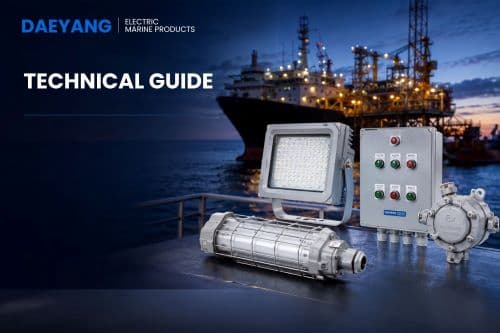
Daeyang Electric Marine Products: Technical Specs Guide
Explosion-proof ratings, switchgear specs, and communication systems for Daeyang Electric marine equipment — a technical guide for marine electrical engineers.
Supplier Spotlight — Marine Boys
Daeyang Electric equipment shows up across a huge range of vessels and offshore installations, but the spec sheets rarely get discussed in plain terms. This piece is aimed at the electrical engineers, class surveyors, and maintenance teams who actually have to select, install, and certify this gear — covering explosion-protection ratings, switchgear classifications, communication network architecture, and sensor technology in more depth than a typical supplier profile.
Explosion-Proof Lighting: Reading the Protection Codes
Daeyang's hazardous-area luminaires are rated across multiple explosion-protection concepts, and the model range reflects real differences in construction, not just labelling:
Protection TypeExample RatingHousingNotesFlameproofEx de IIB T3Cast aluminium body, cast aluminium guard, heat/impact-resistant glassFor Zone 1 hazardous areasFlameproof, higher gas groupEx de IIC T5 (250W) / Ex de IIC T4 (400W)Cast aluminium body, stainless steel guardRated for IIC gases (hydrogen-class), tighter T-class at higher wattageLegacy flameproofEEx de IIB T3 (max 500W) / EEx de IIB T4 (70W)Cast aluminium, hard/impact-resistant glassOlder EEx nomenclature, still seen in existing fleet documentationNon-sparking / restricted breathingEx nR II T2Deep-drawn stainless steel sheet, high-reflectance aluminium reflectorSuited to deck, hold, and chemical processing areas where full flameproof isn't mandatedCopper-free construction—Aluminium die-cast body, mounting and guard limited to <0.4% copper contentRequired in acetylene-risk environments where copper alloys can form sensitive acetylides
For engineers specifying replacements, the gas group (IIA/IIB/IIC) and temperature class (T1–T6) need to match the area classification exactly — Daeyang's R&D documentation notes their explosion-proof design work is built around this three-axis framework: zone (0/1/2), explosion class (IIA/IIB/IIC), and ignition temperature class (T1–T6). Fixtures are certified to IECEx and ATEX, with LCIE and BASEEFA(2001) certification history going back to the early 2000s, so cross-referencing an existing IECEx certificate number against Daeyang's registry is usually the fastest way to confirm equivalence when doing a like-for-like replacement.
Switchboards and Power Distribution
Daeyang's switchgear line includes Class 1E switchgear and local control systems certified under KEPIC (Korea Electric Power Industry Code) — relevant if you're working on vessels or systems with nuclear-adjacent classification requirements, though the bulk of the switchboard range serves standard marine distribution: watertight and non-watertight receptacles and switches, and reefer container receptacles built in 316L stainless steel to IP67, using welded (not gasket-assembled) construction for the waterproof gland — a detail worth checking against spec if you're used to bolted/gasketed alternatives, since the welded approach changes the maintenance and repair pathway if a gland ever needs replacing.
Communication Systems: ADICS-21 and EM-LOG
This is the part of Daeyang's catalogue least visible to the commercial marine sector, since most of the documented deployment history is with the Republic of Korea Navy — but the underlying architecture is worth understanding if you're working with integrated ship control networks:
ADICS-21 is a decentralised optical loop network for medium/large naval vessels, structured as a bus system with cross-redundant optical lines and an optional Ethernet layer. It runs as a 155 Mbps TDMA/IP network supporting digital voice and data exchange for up to 2,048 users — architecturally closer to a SONET/TDMA hybrid than a standard shipboard LAN, which explains the redundancy built into the physical layer.
EM-LOG is a speed-through-water and voyage-distance measurement system using a sensor projected from the hull, returning a signal response used to calculate vessel speed — a more traditional electromagnetic log design, distinct from Doppler or GPS-referenced logs.
Underwater Systems: UUV Development Timeline
Daeyang's underwater systems division has a longer engineering track record than most commercial buyers realise. Company documentation lists a 400m SAUV (Semi-Autonomous Underwater Vehicle) completed in 2003, followed by a 6,000m-rated UUV in 2006 — at the time, the fourth country in the world to reach that depth rating. This underwater systems group continues to lead ROV, AUV, and MDV (Mine Disposal Vehicle) development regionally, with an MDV delivered to the Korean Navy in 2012.
Industrial Sensors: MEMS and SoC Design
Sold under the "TheSen" brand, Daeyang's sensor range is built on MEMS (Micro-Electro-Mechanical Systems) fabrication and custom SoC (System-on-Chip) design rather than repackaged third-party sensor cores. Two points worth flagging for engineers evaluating these for retrofit work:
A solid-state temperature sensor designed as a drop-in replacement for wire-type Pt (platinum RTD) sensors, offering higher resistance to physical vibration and shock, and a smaller footprint — relevant anywhere a traditional Pt100 probe is failing due to mechanical fatigue rather than drift.
Pressure sensors originally developed for automotive ESC (Electronic Stability Control) applications, repurposed into Daeyang's industrial sensor range — an example of the cross-industry design reuse that comes from in-house MEMS fabrication rather than sourcing sensor elements externally.
Certification Base Engineers Can Rely On
Across the full catalogue, Daeyang holds certification from ABS, DNV, KR, LR, GL, BV, NK, RINA, and CCS class societies, plus IECEx, ATEX, ISO 9001, ISO 14001, ISO 45001, UL, and KGS marks, with more than 2,200 individual product certificates on record. For engineers doing type-approval paperwork, this breadth generally means an equivalent certificate already exists for most classification societies rather than requiring a new type test.
"What explosion-proof rating does Daeyang Electric marine lighting use?"
"What class societies certify Daeyang Electric equipment?"
"What is the ADICS-21 communication system?"
"How deep can Daeyang's underwater vehicles operate?"
If you're specifying Daeyang equipment for a build, refit, or compliance replacement and need certificate numbers, technical drawings, or model-specific datasheets, Marine Boys can source documentation directly from the manufacturer. Contact us on sales@marineboys.com.au
Daeyang Electric Marine Products: Technical Specs Guide

Explosion-proof ratings, switchgear specs, and communication systems for Daeyang Electric marine equipment — a technical guide for marine electrical engineers.

Read more → https://www.marineboys.com.au/blog/daeyang-electric-marine-products-technical-guide

#DaeyangElectric #marineelectricalengineering #explosionprooflighting #IECEx #ATEX #marineswitchgear #shipboardcommunicationsystems #MEMSsensors #Koreanmarinesuppliers #offshoreequipment #classcertification #MarineBoys
Copy the caption, click Open LinkedIn, paste, and attach the cover image.